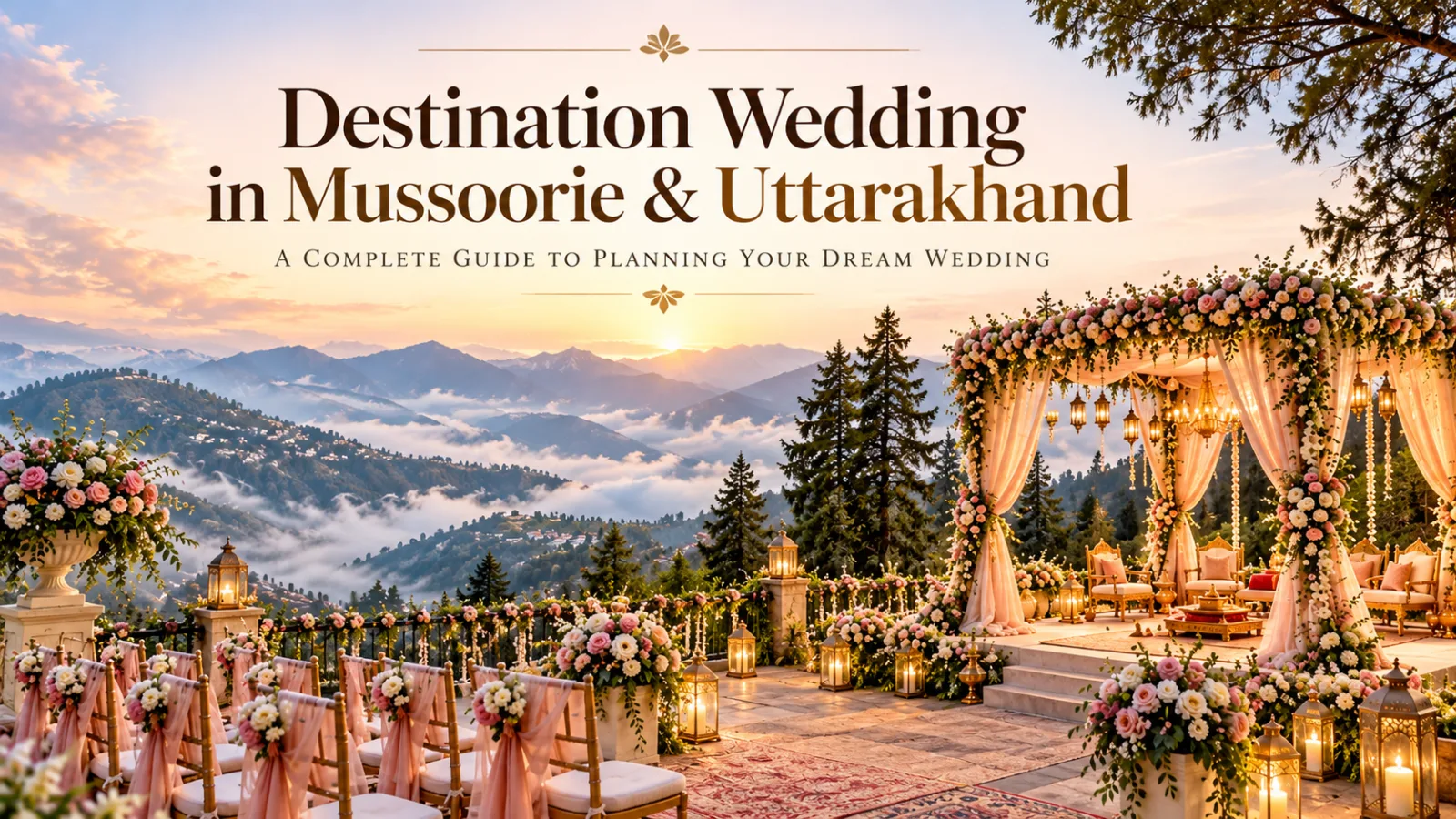
If you are considering a destination wedding in Mussoorie, the first question should not be:
“Which venue looks the most beautiful?”
The better question is:
“Which destination will work best for our guests, functions, season and wedding style?”
Mussoorie naturally photographs beautifully. Mountain views, colonial character, changing light, cool evenings and the Doon Valley below give weddings here a personality that is difficult to recreate in a standard city ballroom.
But a successful hill wedding depends on much more than the setting.
The venue needs to work. Guests need to arrive comfortably. Rooms need to be available. Weather needs a backup plan. Production vehicles need access. Elderly guests need easy movement. And the event schedule has to respect the geography of the hills.
That is where destination wedding planning really begins.
For families considering Mussoorie, Dehradun or another Uttarakhand destination, here is how an experienced event organiser would approach the decision.
Why Mussoorie Is in a Bigger Wedding Conversation?
Mussoorie has always been one of North India’s best-known hill stations, but its role in the premium wedding market has become more visible.
The WeddingSutra Luxury Survey 2026 identifies Mussoorie, Dehradun, Rishikesh and Ramnagar among destinations seeing sustained wedding-market growth as connectivity and premium hotel inventory improve.
Mussoorie also received national attention in 2026 when a high-profile Indian cricket wedding took place in the hill station, further strengthening its visibility as a setting for private premium celebrations. Coverage of the Mussoorie wedding in 2026 shows how naturally the destination fits intimate, high-profile hospitality.
At the same time, Uttarakhand has been promoting wedding tourism more actively, with Mussoorie and other destinations appearing in the state’s wider destination-wedding push.
So this is no longer simply about choosing a pretty hill station. There is now a broader destination-wedding ecosystem developing across the state.
Is Mussoorie Good for a Destination Wedding?
Yes particularly for families looking for a mountain setting, premium hospitality and a destination that remains relatively accessible from North India.
But Mussoorie works best when the wedding is planned around the destination rather than forcing a city-style schedule into the hills.
Official Uttarakhand Tourism information for Mussoorie highlights the hill station’s mountain setting, distinctive winterline and mature tourism infrastructure.
That landscape provides the atmosphere.
The planning team has to make everything else comfortable.
A Mussoorie wedding can work especially well for intimate luxury weddings, two- or three-day celebrations, family-focused weddings with most guests staying at one property, outdoor daytime functions followed by indoor or semi-indoor evenings, and couples who prefer mountain scenery over palace-style grandeur.
The destination becomes more complex when the guest list is very large, accommodation is spread across multiple properties or the schedule requires constant movement between venues.
That does not make those weddings impossible. It simply means logistics need to be designed first.
Think About the Guest Journey Before the Mandap
For destination weddings, the guest experience starts before the first function.
Imagine a relative travelling from Delhi. They may arrive by road, rail or air into Dehradun and then continue uphill.
Now multiply that journey across 150, 250 or 400 guests arriving at different times.
This creates questions that are not glamorous, but they directly affect how luxurious the wedding feels.
Who is collecting guests? Where does the transport desk operate? How are vehicles identified? What happens if a train or flight is delayed? Which hotel does each family go to? Who handles luggage? Can senior guests check in quickly? Will refreshments be available? How do guests know when they need to leave for the first event?
These details are what turn destination logistics into hospitality.
A premium wedding should never make the guest feel like they are managing their own itinerary.
Why Dehradun Is Important for a Mussoorie Destination Wedding?
Mussoorie and Dehradun should often be planned as one connected wedding ecosystem.
Dehradun provides the stronger transport and procurement base. It can support arrivals, staging, vendor movement, supplies and coordination before guests or equipment move uphill.
For families looking for a local planning conversation before finalising a destination, Panchhi Events is based in Dehradun. You can find Panchhi Events in Dehradun or explore the team’s wedding and social event work.
That local understanding becomes especially useful when the wedding involves both Dehradun and Mussoorie for example, guest arrivals in the valley followed by celebrations in the hills.
What Is the Best Time for a Destination Wedding in Mussoorie?
There is no single “best” month because different families want different experiences.
For planning purposes, spring and post-monsoon autumn are among the most comfortable windows for hill weddings. A practical Uttarakhand destination-wedding season guide recommends roughly March to early June and late September to November for favourable conditions across many hill destinations.
Mussoorie’s tourism information also notes the well-known winterline phenomenon, which can make autumn and early-winter sunset functions especially memorable.
-
March to June - This period can be excellent for daytime celebrations, garden functions and outdoor photographs. Evenings may still become cool, so guest comfort should be considered. Late spring and early summer are also popular tourism periods, which can tighten availability.
-
July to September - The hills become exceptionally green, but monsoon weather creates additional risk. Rain, road conditions, fog, outdoor setup and guest transport all require stronger contingency planning. A monsoon wedding can be beautiful, but it should never depend entirely on an uncovered lawn.
-
October and November - This is an attractive window for families who want clear mountain views, pleasant days and cooler evenings. Outdoor ceremonies can work well, while evening events may need heating or protected spaces depending on conditions.
-
December to February - A winter wedding can create a distinctive atmosphere, but cold-weather guest comfort becomes a serious planning consideration. Outdoor ceremonies should be timed carefully, and the venue should have strong indoor alternatives.
The principle is simple:
Choose the season according to the wedding you want not only the photograph you saw online.
Choosing a Wedding Venue That Works as Well as It Looks
When people shortlist a destination wedding venue, photographs often dominate the decision. From an organiser’s perspective, the prettier property is not always the better wedding venue. Before confirming any hotel or resort, examine five practical areas:
-
Total guest rooms available and how many can realistically be blocked.
-
Number and size of indoor and outdoor event spaces.
-
Production/vendor access and setup timings.
-
Weather backup for every major outdoor function.
-
Guest movement between rooms, lawns, banquet spaces and parking.
The number of rooms matters enormously.
If your wedding requires 140 rooms but the venue has only 70 suitable rooms, you have immediately created a second hotel, shuttle routes, luggage movement and another hospitality desk.
That may still be the right decision but it should be a conscious one.
For many premium weddings, one of the greatest luxuries is simply having everyone together.
Do Not Schedule a Hill Wedding Like a City Wedding
This is one of the easiest mistakes to make.
In a city, guests can move between venues relatively quickly. In Mussoorie, even a short distance on a map can take longer because of narrow roads, traffic, weather or property access.
That changes the schedule.
If guests have to leave one venue after lunch, return to a hotel, change, then travel again for the sangeet, you may have created hours of unnecessary movement.
A better approach is often to reduce transfers. Group events intelligently. Let one venue function in multiple ways. Give guests downtime. Build generous buffers into call times.
Luxury is not squeezing the maximum number of activities into three days.
Luxury is allowing those three days to feel effortless.
A Destination Wedding Should Feel Like the Destination
One reason Uttarakhand is becoming more interesting for premium weddings is that families increasingly want experiences rather than interchangeable décor.
This approach suits Mussoorie particularly well.
The hills already give you atmosphere. There is no need to cover every surface. Use the setting. Work with natural light. Consider local textures. Let morning events feel different from evening events. Give guests time to see the valley.
If the wedding happens during winterline season, even the sunset itself can become part of the experience.
A destination should not merely serve as the background to a wedding.
It should influence how the wedding feels.
Mussoorie, Dehradun, Rishikesh or Jim Corbett?
A useful way to approach Uttarakhand is not to ask which destination is “best”. Ask which destination matches your wedding.
-
Mussoorie suits families looking for mountain views, heritage character and an established hill-station experience.
-
Dehradun provides easier city access, strong logistics and premium venues without requiring every guest to travel into the hills.
-
Rishikesh can work for couples looking for a more spiritual, riverside or wellness-led celebration.
-
Jim Corbett/Ramnagar can work especially well for resort-style destination weddings where larger properties and immersive stays are important.
Other locations such as Tehri and Triyuginarayan are also receiving attention as Uttarakhand expands its wedding-tourism positioning. The decision should come back to guest count, travel, desired experience, venue inventory, season and budget.
How Far in Advance Should You Plan?
For a destination wedding, earlier is usually better.
The wedding planner is not only securing a venue. There may also be hotel inventory, transport, décor, production, photographers, artists, makeup teams, guest hospitality and specialist vendors to coordinate.
If your wedding falls in a popular season — or you want a specific premium property — shortlisting nine to twelve months ahead gives you much more flexibility.
That does not mean a wedding cannot be planned faster. It means fewer decisions need to be made around whatever remains available.
What Should Your First Planning Meeting Cover?
A first meeting with a destination wedding planner does not need a forty-page brief.
It needs clarity on the fundamentals.
Come prepared with your approximate dates, preferred destination, estimated guest count, number of functions, likely hotel-room requirement, whether most guests are local or travelling, your broad budget framework, and the three things you care about most.
Those priorities are important.
Perhaps hospitality matters more than elaborate décor. Perhaps your family wants a very private celebration. Perhaps food is central. Perhaps you want one exceptional musical evening. Perhaps guest comfort for elderly relatives determines the venue.
There is no universal luxury wedding format.
A good plan should be built around your family, not around a standard package.
Where Does the Wedding Planner Add the Most Value?
In a destination wedding, the planner sits between multiple moving systems: the family, venue, hospitality team, decorators, production, artists, transport, photographers, caterers, local vendors and guests.
The planner’s job is not simply to book these people.
It is to make sure their work connects.
The decorator needs the venue’s setup window. The AV team needs power and stage drawings. Guest transport needs function timings. The photographer needs ceremony cues. The hospitality desk needs rooming information. Artists need technical requirements. The family needs one clear point of coordination.
When those systems are connected properly, the wedding feels simple from the outside.
That is the real purpose of professional destination wedding planning.
Planning Your Wedding in Mussoorie or Uttarakhand?
If you are still at the venue-shortlisting stage, begin with your guest count, room requirement and preferred season. Then compare destinations.
View Panchhi Events’ wedding and social celebrations and browse the event gallery to understand the range of event formats handled by the team.
For client experiences and trust signals, visit Panchhi Events — Trusted By. To understand the company background, see About Panchhi Events.
For a local planning discussion in Dehradun, use Panchhi Events’ Google location.
When you are ready to discuss the date, guest count and destination shortlist, contact Panchhi Events.
Frequently Asked Questions
Is Mussoorie a good location for a luxury destination wedding?
Yes. Mussoorie combines a mountain setting, established hotel infrastructure and proximity to Dehradun. It is particularly well suited to destination weddings where families want premium hospitality and a more intimate hill-station atmosphere.
What is the best month for a destination wedding in Mussoorie?
March to early June and approximately October to November are among the most practical periods for outdoor and mixed indoor-outdoor celebrations. Winter can also be beautiful, but cold-weather planning becomes more important. Monsoon weddings require stronger indoor backups and transport contingency plans.
How do guests usually reach Mussoorie for a wedding?
Many guests travel via Dehradun and continue by road to Mussoorie. The exact transport plan should be built around where guests are arriving from, their arrival times and the venue location. Group transfers are generally easier to manage than leaving every guest to arrange individual transport.
Should all wedding guests stay at the same hotel?
Where room inventory allows, keeping most guests together can simplify hospitality and transport considerably. For larger weddings, multiple properties may be necessary, in which case room allocation and shuttle planning should be finalised early.
How many days are ideal for a Mussoorie destination wedding?
Two to three nights works well for many destination celebrations, depending on the number of functions. The schedule should leave enough time between events so guests can rest and enjoy the destination.
Do we need an indoor backup for an outdoor Mussoorie wedding?
Yes. Any major outdoor hill wedding should have a credible weather backup. The alternative space should be large enough and operationally ready, not simply listed as an emergency option.
Why hire a local destination wedding planner in Dehradun for a Mussoorie wedding?
A planner based close to the destination can bring practical knowledge of routes, venues, local vendors, production movement, guest logistics and hill-specific operating conditions. This becomes especially useful during venue visits and on-ground execution.
What information should we share before requesting a wedding proposal?
Share your tentative dates, destination preference, guest count, number of functions, estimated room requirement and approximate budget framework. These details allow an event planner to suggest a much more realistic scope than a generic package.