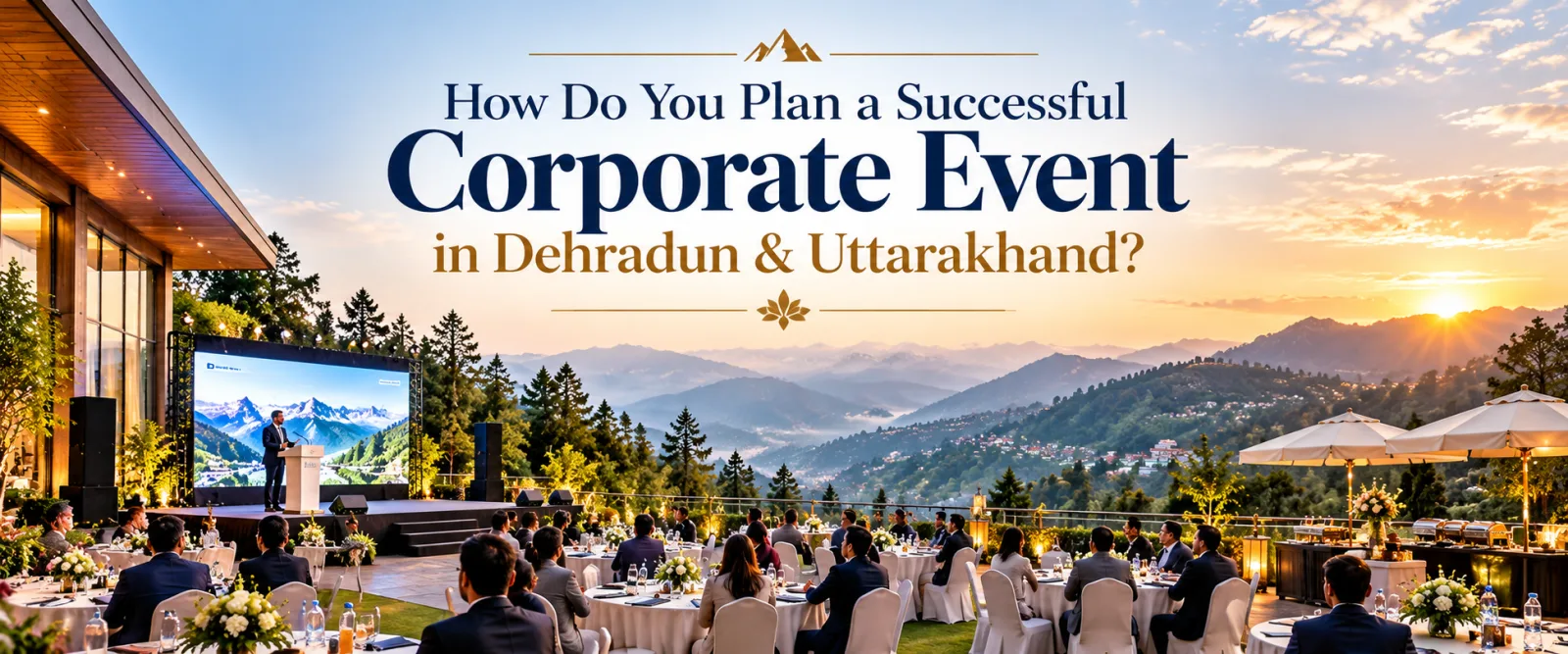
A corporate event should begin with a business question, not a stage design.
- What should the audience understand?
- What should employees feel?
- What should customers remember?
- What needs to happen after everyone goes home?
Those questions matter far more than whether the LED wall is twelve feet or twenty feet wide.
For a company planning a conference, leadership retreat, product launch, dealer meet, annual celebration or executive gathering in Dehradun or Uttarakhand, professional corporate event management is ultimately about turning a business objective into an organised live experience.
That requires strategy, production, hospitality, technology and disciplined execution working together.
What Does a Corporate Event Management in Dehradun Actually Do?
A professional corporate event management company coordinates the complete event from the initial brief and venue selection to production, branding, AV, guest logistics, hospitality, vendor management, run-of-show and on-site execution.
Depending on the event, the scope may also include conference planning, stage and set production, LED and audiovisual systems, registration, product-launch production, signage, entertainment, hotel coordination, transfers, team-building activities, leadership retreats, awards, photography, video, live streaming and post-event feedback.
The important point is that these elements should not operate independently.
The venue affects production. Production affects the agenda. The agenda affects catering. Guest movement affects session timings. The event objective affects almost everything.
A strong planner connects those decisions before they become problems.
What Companies Expect From Corporate Events Today?
For years, companies often measured an event through fairly simple questions: How many people attended? Did the programme run on time? Was the food good? Did leadership like the venue?
Those things still matter, but the business expectation is becoming more sophisticated.
The EY–BookMyShow analysis of India’s live-events and experiential-marketing market reflects the growing role of live experiences as a brand-engagement channel.
That changes the job of an event planner.
A product launch cannot simply look impressive. It needs to communicate the product clearly.
An employee offsite cannot simply provide a resort stay. It should strengthen connection, recognition or alignment.
A dealer meet needs to make partners feel valued while communicating commercial priorities.
A leadership event needs enough privacy and comfort for genuine discussion.
A conference should help people connect not simply watch presentations for eight hours.
Why Companies Are Looking Beyond the Traditional Metro Ballroom?
Delhi, Gurgaon, Mumbai, Bengaluru and Hyderabad remain major corporate-event markets.
But companies are increasingly willing to consider destinations outside the biggest metros for certain meetings, incentives, retreats and conferences. The broader 2026 MICE outlook for India reflects increasing acceptance of regional destinations as connectivity, hotel infrastructure and event capability improve.
This is where Dehradun becomes interesting.
Its advantage is not that it competes with Delhi as a giant exhibition centre. Its advantage is different.
Dehradun works particularly well when a company wants to combine business with a change of environment.
A leadership meeting can remain professional without feeling like another office day. A team retreat can include structured sessions and time outdoors. A corporate conference can bring together attendees from North India while giving them access to the wider Uttarakhand region.
Mussoorie, Rishikesh and other nearby destinations can extend that experience depending on the brief.
When Does Dehradun Make Sense for a Corporate Event?
Not every event needs to leave the metro.
Dehradun is particularly worth considering for leadership offsites, regional conferences, dealer and distributor meets, product launches, annual days, awards, corporate retreats and team events.
Leadership Offsites
A leadership team often needs something a boardroom cannot provide: time.
Time for strategy. Time for conversation. Time away from daily interruptions.
For these events, the venue should support formal sessions and informal discussion. Privacy can matter more than ballroom capacity.
Corporate Conferences
Dehradun can work for regional conferences, association gatherings, training programmes, institutional conferences and sector meetings where attendees are coming primarily from North India.
Here the priorities become venue capacity, stage and AV, registration, session timing, speaker movement, food service, branding and transport.
Dealer and Distributor Meets
Dealer meets often combine business presentations with recognition, networking or entertainment. A planner has to manage both the commercial and hospitality sides of the programme.
Product Launches
Product launches are often production-heavy. Lighting, reveal timing, screen content, photography positions, media visibility and technical rehearsal become critical.
A five-second product reveal may require hours of preparation.
Annual Days and Award Events
Recognition events depend heavily on pacing. Award categories, winner lists, walk-up time, music cues, stage photographs, speeches and dinner service need one coordinated run-of-show.
Corporate Retreats and Team Events
These events may be less about presentation and more about connection. Formal sessions might occupy only part of the programme, with the rest including outdoor activities, wellness, team exercises, entertainment or destination experiences.
The format should reflect the team, not a standard “corporate package”.
Start With a One-Page Brief Before Calling Vendors
One of the best ways to avoid confusion is to create a simple one-page brief first. It should answer seven questions.
Why are we holding this event? Employee engagement, product awareness, leadership strategy, dealer recognition, training, networking, celebration or another objective?
Who is attending? Employees, CXOs, dealers, customers, government stakeholders, partners, media or international delegates?
How many people are expected? A 60-person leadership retreat and a 600-person annual event are completely different productions.
Where are attendees travelling from? Local attendance requires one plan; guests arriving from several states require another.
What does leadership expect? The person organising the event and the person approving it may have different expectations.
What is the budget framework? A planner does not need the exact last rupee on day one, but they do need a realistic range.
What would make the event successful? Attendance, delegate satisfaction, qualified leads, employee participation, product demonstrations, media coverage, NPS or something else?
The event should be designed around those answers.
The Venue Is an Operational Decision, Not Just a Visual One
Corporate teams frequently shortlist venues based on photographs, location and room rate.
That is not enough.
A venue has to support the event operationally.
For a conference or corporate gathering, ask:
How many attendees can the main hall seat comfortably? Is the room pillar-free? How high is the ceiling? Where will the LED screen go? Can the venue support the electrical load? Where do speakers wait before going on stage? Is there enough registration space? Can lunch service handle everyone without delaying the programme? How will production equipment enter? Is there enough parking? If delegates are staying overnight, how many rooms are genuinely available?
The audience may never notice the answers.
But they will notice the consequences if those questions were never asked.
AV Is No Longer a Supporting Item
A decade ago, audiovisual planning was often treated as a technical line item: microphones, projector, speakers, done.
That approach does not work for many 2026 corporate events.
Presentation quality, video, streaming, digital content and audience interaction now form part of the experience itself. Current thinking on enterprise AV and AI-enabled collaboration shows how rapidly audiovisual systems are becoming part of broader digital strategy.
For an event, the practical questions include:
How many screens does the room require? Can the last row read the presentation? How will remote participants join? Who controls playback? Does the CEO require confidence monitors? Are there panel discussions? How many wireless microphones are needed? Does the event require recording? Is there simultaneous translation? Will footage be repurposed later?
The AV plan should be built around the programme not added two days before the event.
AI Is Entering Event Planning, but It Is Not Replacing the Event Manager
One of the most relevant 2026 developments is the growing use of AI across the MICE industry.
Industry discussion around AI-assisted event planning shows AI increasingly supporting venue research, sourcing, forecasting, data processing and operational planning.
That distinction matters.
AI can compare information quickly. It can structure agendas, support attendee communication, summarise feedback and assist with registration or networking systems.
But it cannot stand backstage and decide what to do when a keynote speaker arrives twenty minutes late while lunch service is already scheduled.
Technology improves the plan.
People still execute the event.
Corporate Events Are Becoming More Experience-Led
The most successful corporate events increasingly do not feel like long sequences of PowerPoint presentations.
People are asking for interaction, shorter sessions, better networking, more comfortable environments, live demonstrations, entertainment, destination elements and informal conversation.
This does not mean every conference needs immersive technology or a celebrity act.
It means the format should respect the audience’s time.
If someone has travelled several hours to attend, give them something they could not have received in an email or video call.
Production Should Support the Brand
Corporate event branding is not simply placing a logo on the stage.
The event itself communicates the organisation.
A premium financial-services company should not look like a college festival. A technology launch should not feel visually static. A government or institutional conference requires different discipline from an employee celebration. A luxury consumer brand may need highly controlled visual details.
Branding can include stage architecture, LED content, registration counters, signage, photo moments, table design, speaker screens, presentation templates, product zones, backdrops, name badges, menus and gifts.
But consistency matters more than quantity.
Strong event branding feels connected.
Weak event branding feels like logos have been placed everywhere.
The Run-of-Show Is One of the Most Important Documents
Guests never see it.
Leadership may never read it.
But the run-of-show is often what separates professional execution from improvisation.
A proper corporate event run sheet can include exact timings, speaker movements, presentation cues, music, video playback, photography positions and catering triggers.
Behind every timing are additional instructions: which microphone, which presentation, which music cue, who escorts the speaker, where the photographer stands, and who informs catering if the programme is running late.
This level of planning is what prevents the audience from seeing the machinery of the event.
Corporate Hospitality Is Different from Wedding Hospitality
A wedding guest is usually there for celebration.
A corporate delegate may be there for business, networking, recognition, learning or obligation.
That changes expectations.
Registration should be fast. Signage should be obvious. Room allocations should be accurate. Wi-Fi should work. Session timings should be respected. Food service should not derail the agenda. Leadership should not wait for transport. Speakers should know where to go.
Premium corporate hospitality is not decorative.
It is efficient.
Sustainability Is Becoming a Business Requirement
Sustainable events used to be discussed mainly as an optional “green” idea.
That is changing.
The wider Indian MICE outlook points to stronger interest in paperless operations, waste reduction, efficient infrastructure and ESG-linked supplier expectations.
For companies with sustainability commitments, event planning may need to consider digital registration, reduced single-use plastics, reusable stage materials, local procurement, waste segregation, responsible gifting, efficient transport and digital agendas.
The most effective approach is usually practical rather than theatrical.
Measurement Should Be Planned Before the Event
Corporate events often need to justify the investment.
That requires data.
Useful metrics vary by event.
For a conference: attendance rate, session participation, delegate feedback and networking participation.
For a product launch: qualified leads, demonstrations, media interactions, content reach and follow-up meetings.
For an employee event: attendance, survey scores, recognition participation and employee feedback.
For a dealer meet: partner attendance, meetings completed and post-event actions.
Research into India’s wider events and experiences industry also highlights the value of professional and social connection at live events.
If measurement matters, build it into the event from the beginning.
Do not ask two weeks later: “What should we report?”
How Far in Advance Should a Corporate Event Be Planned?
There is no universal timeline.
A small executive meeting may need several weeks. A 100–300 person conference benefits from a few months where possible. A large annual event or awards night should begin earlier, particularly if production is complex. A destination offsite should start early enough to secure room inventory and transport.
Peak wedding periods can also affect corporate-event venue and hotel availability in Dehradun and Uttarakhand because corporate events compete for the same rooms, lawns, ballrooms and production vendors.
What Should You Ask a Corporate Event Management Company Before Hiring Them?
Do not begin with, “What is your package?”
Corporate events are rarely well served by generic packages.
Instead ask what information is needed before a proposal, who will be the single point of contact, who manages production on event day, how the run-of-show is controlled, how vendors are coordinated, what happens when the agenda changes, whether outstation guests can be managed, how technical rehearsals work, and what reporting can be captured afterward.
Why Local Execution Matters in Dehradun and Uttarakhand?
Corporate events are often planned by teams sitting in another city. The marketing department may be in Delhi. HR may be in Gurgaon. Senior management may be scattered across India.
The event, however, still happens physically somewhere.
That is why local execution matters.
A team familiar with Dehradun and Uttarakhand can help with venue visits, vendor coordination, local production, transport planning, weather considerations, hotel movement and last-minute operational changes.
For companies planning an event in the region, explore Panchhi Events’ corporate event management services, review real event photographs and setups, learn more about the Panchhi Events team, and see client experiences and testimonials.
For an in-person discussion, find Panchhi Events in Dehradun.
A Simple Corporate Event Planning Checklist
Before requesting proposals, have these details ready:
-
Event objective
-
Event format
-
Date or date range
-
Approximate attendance
-
Audience profile
-
Preferred location
-
Accommodation requirement
-
Production requirement
-
Food and hospitality expectations
-
Branding requirements
-
Entertainment requirement
-
Transport requirement
-
Approximate budget
-
Decision-making team
-
Measurement requirement
The clearer this information is, the more useful the first proposal will be.
What Makes Corporate Event Planning in Dehradun Successful?
What Makes Corporate Event Planning in Dehradun Successful?
A successful corporate event is not about size it is about purpose, planning and execution. The right venue, production, technology, hospitality and schedule should all support the event’s business objective.
Industry research shows the growing value of live experiences. An EY-Parthenon and BookMyShow report valued India’s live events market at around ₹13,000 crore, with 78% of consumers preferring experiences over products.
For businesses planning a conference, corporate offsite, product launch, awards event or dealer meet in Dehradun or Uttarakhand, a well-planned event can strengthen engagement, relationships and brand recall.
Planning a corporate event? Contact Panchhi Events with your date, audience size, location and requirements.
Frequently Asked Questions
What does a corporate event planner in Dehradun handle?
A corporate event planner can manage venue selection, production, AV, stage setup, branding, registration, catering coordination, accommodation, guest logistics, entertainment, vendor management and on-site execution. The exact scope depends on the type and size of event.
What types of corporate events can be organised in Dehradun?
Dehradun can host conferences, leadership meetings, annual days, dealer meets, training programmes, award ceremonies, product launches, institutional events, executive retreats and team offsites.
Is Dehradun suitable for a corporate offsite?
Yes. Dehradun can work particularly well for leadership retreats and company offsites that require professional meeting facilities alongside a change of environment. Nearby Mussoorie and other Uttarakhand destinations can also be considered.
Why hire a local corporate event management company in Dehradun?
A local team can assist with venue visits, vendor coordination, production logistics, transport, hotel movement and on-ground problem solving, especially when the internal company team is based outside Uttarakhand.
How early should we start planning a corporate conference?
For a medium or large conference, starting several months ahead generally gives better venue and production options. Smaller meetings may require less time, while destination offsites and major product launches usually benefit from longer planning.
Can corporate events include hybrid or live-streaming options?
Yes. Depending on the venue and production setup, corporate conferences can include live streaming, remote speakers, recording, digital Q&A and other hybrid features. These requirements should be discussed early because they affect AV and internet planning.
How can companies measure the success of a corporate event?
Useful metrics can include attendance, audience participation, session feedback, NPS, leads generated, meetings completed, brand engagement, employee feedback and post-event actions. The relevant measures depend on why the event was organised.